


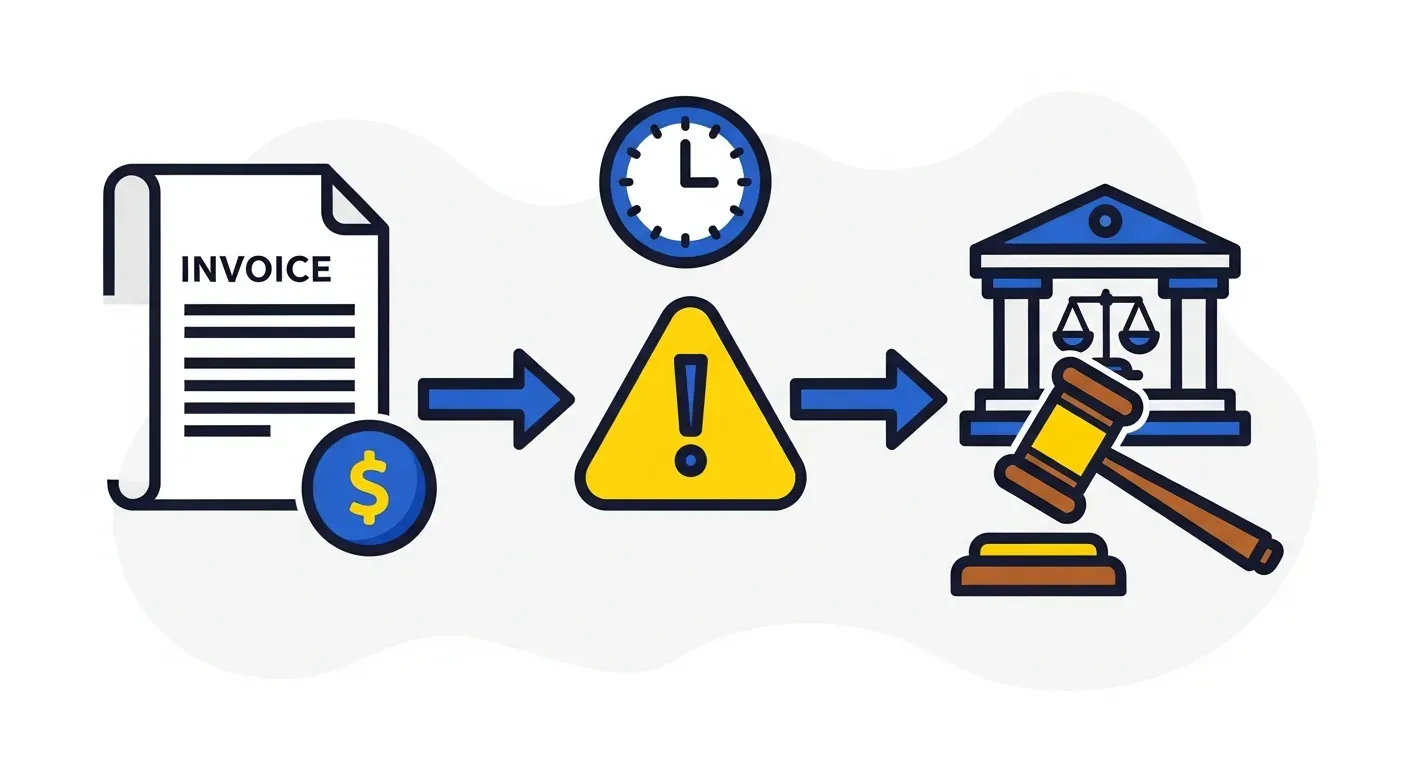
The longer you wait to escalate an unpaid invoice, the less likely you are to recover it. Invoices under 90 days overdue have a 70%+ recovery rate. After 180 days, that drops below 15%. The best approach is structured escalation: automate reminders for the first 60 days, then have a clear policy for when and how to escalate further.
There is a pattern that plays out in finance teams everywhere. An invoice goes overdue. Someone sends a reminder. Then another. Then a third. Weeks pass. The invoice sits in the 60-day bucket, then the 90-day bucket, and eventually someone asks, "Should we do something about this?"
By the time that question gets asked, the odds of recovering the full amount have already dropped significantly.
The data is clear: the sooner you escalate an unpaid invoice, the more likely you are to collect. This guide covers the exact timing, the common mistakes teams make when they wait too long, and how to build an escalation process that protects your cash flow without damaging customer relationships.
How recovery rates decline over time
The relationship between invoice age and recovery rate is not gradual. It is a cliff.
- 1-30 days overdue: 90-98% recovery rate
- 31-60 days: 75-85% recovery
- 61-90 days: 50-70% recovery
- 91-120 days: 30-50% recovery
- 121-180 days: 15-30% recovery
- 180+ days: 5-15% recovery
Invoices escalated before 90 days are roughly twice as likely to be recovered compared to those that age past 180 days. Every week you wait is not neutral. It is actively reducing your chances.
Why most teams wait too long
Three misconceptions keep finance teams from escalating on time:
"Collections will ruin the relationship." In most cases, the opposite is true. Customers who are struggling with cash flow or have internal approval bottlenecks often respond better to a structured escalation than to a fifth polite reminder that they can safely ignore. Professional escalation communicates that you take your business seriously.
"Collections are a last resort." This framing causes teams to exhaust every other option first, burning weeks in the process. Collections should be a standard stage in your AR workflow, not an emergency response. The most effective finance teams treat escalation as a routine process, not a dramatic decision.
"It is not worth it for small invoices." Small unpaid invoices set a precedent. If a customer learns that a $500 invoice can be ignored without consequence, they will test the boundary on larger amounts. Consistent enforcement across all invoice sizes establishes clear expectations.
When to escalate: a decision framework
Consider escalation when any of these conditions are met:
- The invoice is 60-90 days overdue and automated reminders have not produced a response
- Multiple contact attempts have been ignored across different channels (email, phone, SMS)
- The customer has broken a payment promise (said they would pay by a specific date and did not)
- A dispute has been raised but not resolved despite reasonable attempts at resolution
- The customer has gone silent and is no longer responding to any communication
You do not need all five. Any one of these is a valid trigger, and waiting for the perfect combination costs you recovery probability every day.
What to do before you escalate
Escalation works best when it follows a documented process. Before sending an invoice to collections:
1. Confirm the invoice is accurate. Verify the amount, purchase order number, delivery confirmation, and customer contact details. Nothing undermines an escalation faster than a disputed line item.
2. Document all communication. If you use Yonovo, your reminder history is already tracked automatically. If not, compile a record of every email, call, and message sent about this invoice.
3. Send a formal final notice. Give the customer a specific deadline (7-14 days) and clearly state what happens if payment is not received. This is both professional courtesy and legal best practice.
4. Review internally. Check with your sales or account management team. Is there context you are missing? Is there a legitimate dispute that has not reached the finance team?
5. Make the decision and act. Once your process is complete, escalate. Do not re-enter the reminder cycle. The data says every additional week of delay reduces your recovery rate.
How automation changes the escalation timeline
The biggest reason invoices age past 90 days is not a conscious decision to wait. It is that nobody noticed. Manual AR processes create gaps where invoices fall through the cracks, reminders do not get sent, and overdue accounts sit unattended.
Automated AR workflows change this by:
- Sending reminders consistently before and after the due date, across multiple channels (email, SMS, WhatsApp, AI voice calls)
- Flagging invoices that hit your escalation threshold so nothing ages silently in a spreadsheet
- Tracking the full communication history so you have documentation ready if escalation becomes necessary
- Freeing your team to focus on the complex cases that require human judgment instead of sending routine reminders
TDG Inc reduced manual follow-ups by 80% after automating their reminder sequences with Yonovo, which meant overdue invoices got flagged earlier and escalated faster. Their DSO dropped by 15 days in the first 90 days.
Building an escalation policy your team will follow
The best escalation policy is one that is simple enough to follow consistently. Here is a framework:
Days 1-7 before due date: Automated friendly reminder with payment link.
Due date: Automated confirmation that payment is expected today.
Days 1-14 overdue: Automated reminders via email and SMS. Tone is professional and direct.
Days 15-30 overdue: Escalation to a phone call or AI voice call. Direct outreach to the AP contact.
Days 31-60 overdue: Senior contact escalation. Notify the customer's management that the invoice is significantly overdue.
Days 61-90 overdue: Final notice. Formal written communication with a specific deadline and a clear statement of next steps.
90+ days overdue: Escalation to collections or legal review, depending on the amount and relationship.
The key is to define this policy once, communicate it to your team and your customers, and apply it consistently. Inconsistency teaches customers that your deadlines are flexible.
Frequently Asked Questions
How long should I wait before sending an invoice to collections?
Most businesses should consider escalation after 60-90 days of non-payment, assuming you have already sent multiple reminders and attempted direct contact. The key is not to wait until the invoice feels hopeless. Recovery rates drop significantly after 90 days, so earlier escalation consistently produces better outcomes.
Does sending an invoice to collections damage the customer relationship?
Not necessarily. Most customers who pay late are dealing with cash flow issues or internal process breakdowns, not trying to avoid payment. A professional escalation with clear communication often resolves the situation faster than continued gentle reminders. The relationship is more likely to be damaged by months of awkward follow-ups than by a structured escalation.
What is the recovery rate for overdue invoices?
Recovery rates decline sharply with age. Invoices 1-30 days overdue have a 90-98% recovery rate. At 61-90 days, it drops to 50-70%. At 121-180 days, recovery falls to 15-30%. Beyond 180 days, only 5-15% of invoices are typically recovered. These numbers make a strong case for early, structured escalation.
Should I send small invoices to collections?
Yes. Small unpaid invoices add up and signal to customers that late payment is acceptable. If a customer ignores a $500 invoice, they are more likely to ignore a $5,000 invoice later. Having a consistent policy regardless of invoice size establishes clear expectations.
What should I do before sending an invoice to collections?
Verify the invoice is accurate and was received. Document all communication attempts. Send a formal final notice with a specific deadline. If you use automation, review the reminder history to confirm the customer was contacted multiple times across different channels. Only escalate after these steps are complete.