




At the SaaStr CFO Summit, finance leaders from OpenAI, SnapLogic, and Gorgias agreed on one principle: automate the bottom of the pyramid. Start with the repetitive, low-leverage tasks that keep skilled finance professionals stuck on busywork. The CFO role is shifting from tracking the past to building systems for real-time decisions and growth.
That was the headline at the SaaStr CFO Summit. Bold, maybe a little dramatic. But the conversation that followed it on stage was more compelling than the title.
Today's CFO is not just trying to cut costs. They are trying to free their teams from work those teams are massively overqualified for. Manual reconciliations. Chasing down late payments. Formatting reports. Necessary work, but work that does not require the strategic thinking these people were hired to do.
The speakers included Sowmya Ranganathan (ex-controller at OpenAI), Ahsan Malik (CFO at SnapLogic), and Kunal Agarwal (CFO at Gorgias), moderated by Lloyed Lobo. The conversation centered on a single principle that kept surfacing throughout the day.
Automate the bottom of the pyramid
The framework that resonated most was simple: automate the bottom, refactor the middle, focus your people at the top.
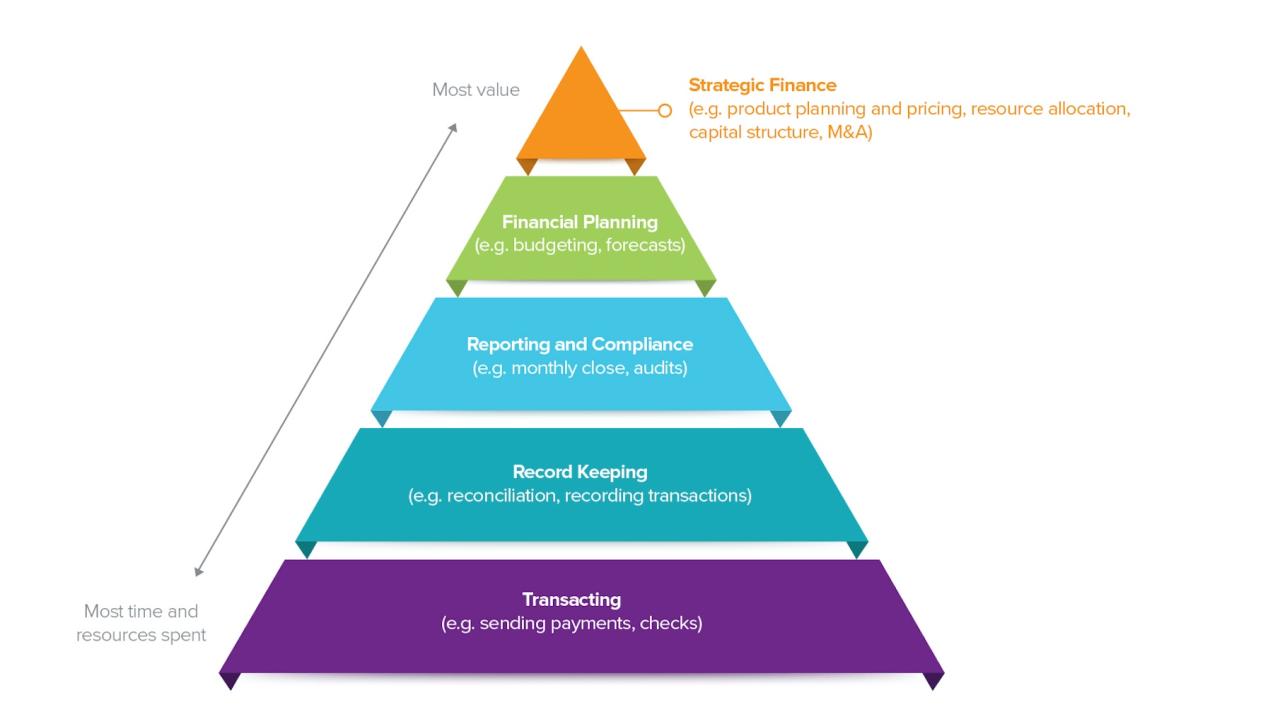
Pyramid framework by Seema at A16Z
The bottom of the pyramid is the repetitive, low-leverage work that consumes the majority of a finance team's time. Sending payment reminders. Matching cash receipts to invoices. Updating aging spreadsheets. Pulling data from one system and entering it into another.
This work is necessary. But it does not require judgment, creativity, or relationship skills. It requires consistency and speed, which is exactly what automation provides.
The middle of the pyramid is process work that benefits from restructuring. Approval workflows, reporting cadences, and cross-functional handoffs. These processes can be streamlined once the manual busywork at the bottom is removed.
The top of the pyramid is where finance leaders want their teams to spend their time. Cash flow strategy. Credit risk analysis. Business partnering with sales and operations. Forecasting that informs real decisions. This is the work that creates value.
How CFOs are deciding what to automate first
A formula many of the speakers referenced for prioritizing automation:
Value + Risk + Need = Automation sweet spot
- Value: How much time or money does this task consume? A process that takes 10 hours per week scores higher than one that takes 1 hour.
- Risk: What is the cost of errors? Manual data entry that causes reconciliation mismatches has higher risk than a task with built-in error checking.
- Need: How urgently does this need to change? If the team is already underwater and hiring is not an option, the need is immediate.
Tasks that score high on all three are where automation delivers the fastest, most visible ROI.
For most finance teams, accounts receivable fits this profile perfectly. AR teams spend roughly 70% of their time on repetitive tasks. Errors in follow-up directly impact cash flow. And the need is constant because invoices never stop coming.
What this means for AR teams
The shift the CFOs described is not theoretical. It is already happening. Finance teams that automate collections are not eliminating AR roles. They are transforming them.
Before automation:
- Sending reminder emails one at a time
- Tracking overdue invoices in spreadsheets
- Manually matching payments to invoices
- Spending hours on the phone chasing responses
After automation:
- Reviewing exception cases that require human judgment
- Analyzing payment patterns to identify credit risk early
- Building relationships with key accounts
- Improving cash flow forecasting accuracy
Troyes made this shift in a single day. They connected Yonovo to their accounting system, automated their reminder sequences across email, SMS, and WhatsApp, and freed up 25+ hours per month. Their payment turnaround improved by 45%.
The CFO role is changing
The speakers agreed on one thing: the CFO role is no longer just about tracking the past. It is about building the systems that enable real-time decisions and growth.
That starts at the bottom of the pyramid. The tasks nobody enjoys, nobody was hired to do, and nobody should be doing manually in 2026.
If your finance team is still spending hours on manual AR processes, the question is not whether to automate. It is why you have not started yet. The tools exist. The ROI is immediate. And your team has better things to do.
See how Yonovo compares to other AR automation platforms, or learn how to reduce your DSO with the strategies finance leaders are already using.
Frequently Asked Questions
What does automate the bottom of the pyramid mean?
It refers to a prioritization framework for finance automation. The bottom of the pyramid contains repetitive, low-value tasks like sending payment reminders, reconciling transactions, and formatting reports. Automating these first frees up finance teams to focus on mid-level work (process optimization) and high-level strategic work (forecasting, planning, growth).
How are CFOs deciding what to automate first?
A framework shared at the SaaStr CFO Summit uses three factors: Value (how much time or money does this task cost?), Risk (what is the cost of errors in this process?), and Need (how urgently does this need to change?). Tasks that score high on all three are the automation sweet spot.
Is automation replacing finance teams?
No. The consistent message from CFOs at the summit was that automation elevates teams, not replaces them. By removing repetitive tasks like manual reconciliation and payment chasing, finance professionals can spend their time on credit analysis, cash flow strategy, and relationship management. These are the skills companies hired them for.
What are the most common finance tasks being automated?
The most commonly automated finance tasks include payment reminders and collections follow-up, invoice reconciliation and payment matching, report generation and formatting, expense categorization, and basic compliance checks. Accounts receivable automation is one of the highest-impact starting points because it directly accelerates cash flow.