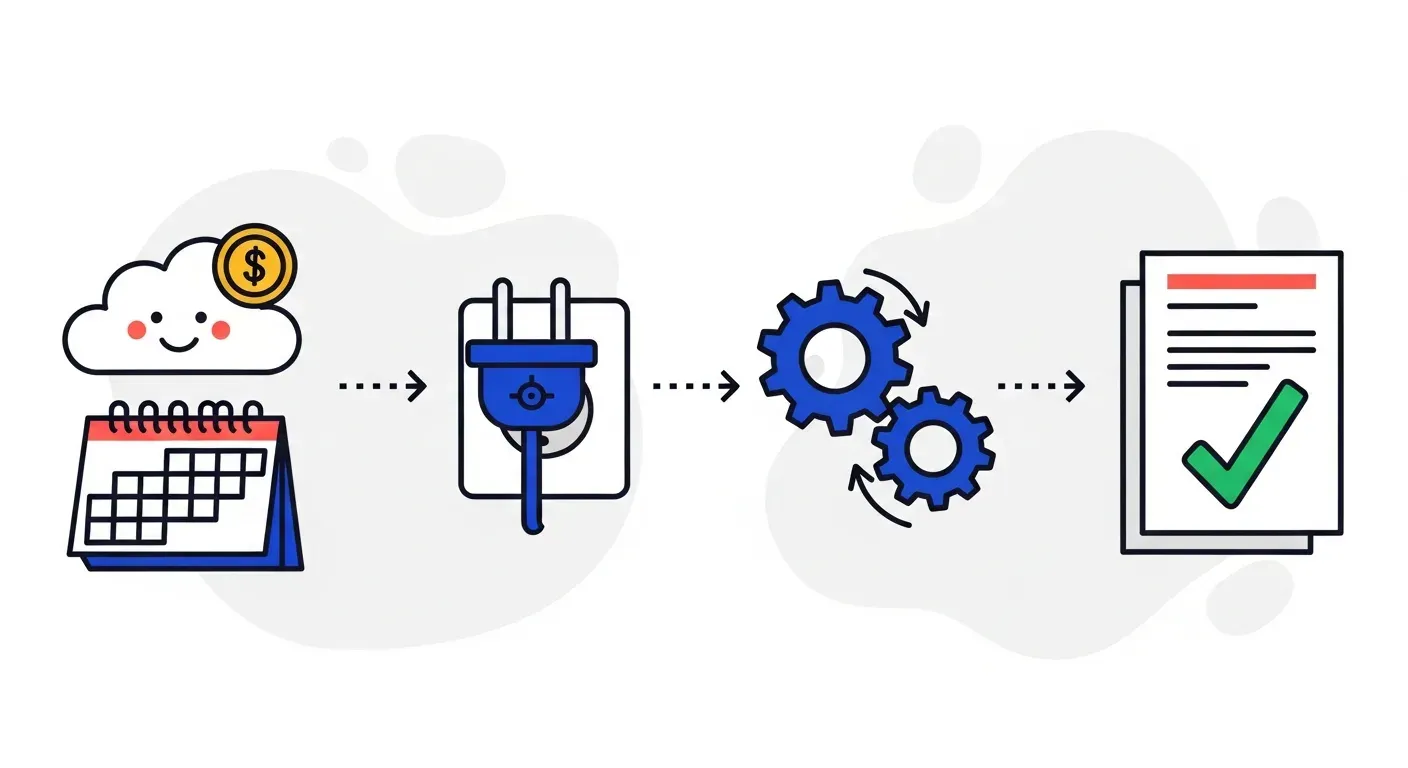




If your DSO is climbing, your team spends more time chasing payments than on strategic work, or invoices regularly fall through the cracks, your AR process needs automation. Most B2B companies hit the tipping point when they are processing more than 100 invoices per month, carrying a DSO above 45 days, or losing staff time to repetitive follow-up tasks that software can handle more consistently. The cost of inaction compounds monthly as overdue balances grow harder to collect.
You have been managing accounts receivable the same way for years. Invoices go out, your team sends follow-up emails when payments are late, somebody updates a spreadsheet, and eventually most customers pay. It works. Sort of. But lately the cracks have been showing: a major invoice slipped to 90 days without anyone noticing, your newest hire just quit because the job was "all data entry," and your CFO is asking why cash flow forecasts are always off.
The question is not whether AR automation exists. You already know it does. The real question is whether your specific process has reached the point where manual methods are actively costing you money, and the answer is almost always visible in the numbers and daily patterns your team already knows.
The five clearest signs your AR process needs automation
Some indicators are subtle. These are not. If you recognize three or more of these patterns, your AR process has outgrown manual management.
1. Your DSO is rising even though revenue is stable or growing
Days sales outstanding is the single most telling metric for AR health. It measures the average number of days it takes to collect payment after an invoice is issued. The median DSO for B2B companies across industries sits around 40 to 45 days. If yours is above that and trending upward, your collections process is falling behind.
Rising DSO with stable revenue means the problem is not on the sales side. It is on the collections side. Your team is issuing invoices but not converting them to cash fast enough. The most common reason is inconsistent follow-up. When your team is manually tracking who needs a reminder, some invoices inevitably get missed, and each missed follow-up pushes that invoice further into aging territory where collection probability drops.
A 10-day increase in DSO might not sound dramatic, but for a company with $5 million in annual revenue, it represents roughly $137,000 in additional working capital tied up in receivables. That is cash you cannot use for payroll, inventory, or growth until it is collected.
2. Invoices are falling through the cracks
This is the most operationally damaging sign. An invoice goes overdue, nobody follows up, and it sits in a spreadsheet aging from 30 to 60 to 90 days while your team focuses on the accounts they remember or the ones that happen to be in front of them.
It does not happen because your team is careless. It happens because manual tracking systems have no built-in alerting. A spreadsheet does not send you a notification when an invoice hits 30 days past due. Your accounting system might generate an aging report, but if nobody pulls it regularly or acts on every line item, invoices slip.
The damage is direct. The Commercial Collection Agency Association reports that accounts over 90 days past due have less than a 75% chance of full collection. An invoice that sits unnoticed for three months is worth significantly less than its face value. Scale that across dozens of invoices and the write-off impact becomes material.
3. Your team spends more than half their time on repetitive tasks
Ask your AR team what they actually do each day. If the answer is some combination of sending reminder emails, updating spreadsheets, checking who has paid, matching payments to invoices, pulling aging reports, and copying data between systems, then the majority of their time is going to tasks that software handles more consistently and at a fraction of the cost.
This matters for two reasons. First, repetitive manual work is where errors live. A mistyped invoice number, a reminder sent to the wrong contact, a payment recorded against the wrong account. These errors create downstream problems that take even more time to fix.
Second, your skilled finance staff should be doing work that requires human judgment: negotiating payment plans with struggling customers, analyzing credit risk, identifying customers who might churn, and optimizing your collections strategy. When they are buried in data entry and email templates, you are paying for expertise you are not using.
4. You cannot answer basic AR questions in real time
Your CFO asks: "How much is overdue right now?" Your sales team asks: "Has this customer paid their last three invoices?" Your controller asks: "What is our collection rate by aging bucket?"
If answering any of these questions requires pulling data, building a report, or saying "I'll get back to you," your process lacks the visibility that effective AR management requires. These are not complex analytics questions. They are basic operational questions that should be answerable in seconds from a live dashboard.
The inability to answer them quickly is not just an inconvenience. It means decisions are being made on stale or incomplete data. Credit approvals happen without current receivables context. Cash flow forecasts are built on last week's numbers. Sales closes deals with customers who already owe you money they have not paid.
5. You have lost (or are about to lose) AR staff
AR clerk turnover is a leading indicator that your process needs automation. The role, when it consists primarily of manual data entry and repetitive email follow-ups, is one of the least engaging in finance. The people doing the work know it could be automated, and they leave for roles where they do more meaningful work.
High turnover creates a compounding problem. Each new hire needs weeks to learn your customers, your systems, and your follow-up cadences. During that ramp-up period, collections performance drops. And the institutional knowledge about which customers need gentle reminders versus firm escalation walks out the door with every departure.
The benchmarks that matter
Beyond the five warning signs, there are specific benchmarks that help you assess whether automation would deliver meaningful ROI for your business.
Invoice volume thresholds
At fewer than 50 invoices per month, a competent AR person can manage follow-ups manually with minimal gaps. At 100 to 200 invoices per month, consistent follow-up on every overdue invoice becomes difficult for a single person. At 500 or more, it is impossible without either a large team or automation.
The threshold is lower than most finance leaders think because it is not just the invoices that scale. Each overdue invoice generates a chain of follow-up actions: initial reminder, second reminder, escalation, phone call, documentation. An AR team member handling 200 invoices is not just tracking 200 items. They are managing potentially 400 to 600 follow-up actions per month, each requiring the right timing, the right channel, and the right message.
Customer count thresholds
The number of unique customers matters as much as invoice volume. Managing AR for 20 large customers that each send a few invoices monthly is fundamentally different from managing 200 customers that each send one or two invoices. More customers means more relationships to maintain, more contact details to keep current, more communication preferences to track, and more chances for a customer to slip through the cracks.
For wholesale distribution and manufacturing companies with hundreds or thousands of active customer accounts, manual AR management becomes a game of whack-a-mole where the team reacts to whoever is making noise rather than systematically working through the receivables portfolio.
Revenue-at-risk calculations
Calculate your total overdue balance right now. What percentage of your total AR does it represent? For most B2B companies, 20% to 30% of receivables are past due at any given time. Now calculate what it costs you to carry that overdue balance.
If your business borrows on a line of credit, the carrying cost is straightforward: your interest rate times your average overdue balance. At 8% annual interest on $500,000 in overdue receivables, you are paying $40,000 per year just to finance the cash your customers owe you.
If you do not borrow, the cost is the opportunity you miss. That $500,000 could be invested in inventory, equipment, hiring, or growth. The return on that capital, whatever it would have been, is the true cost of slow collections.
The hidden costs most teams miss
The obvious costs of manual AR (staff time, write-offs, slow cash flow) are easy to quantify. The hidden costs are often larger.
Relationship damage from inconsistent follow-ups
When follow-up quality depends on who is handling the account and how busy they are that week, your customers get an inconsistent experience. One customer gets a polite reminder on day 3, while another hears nothing until day 45 when they receive an urgent demand. Neither experience builds trust.
Worse, manual processes occasionally chase invoices that have already been paid. Nothing damages a customer relationship faster than demanding payment for an invoice they settled last week. This happens because manual tracking systems lag behind actual payment activity. The payment was posted in QuickBooks or Xero, but the AR team's spreadsheet has not been updated yet.
Missed dispute signals
A customer who stops responding to emails is telling you something. A customer who pays most invoices on time but suddenly goes 30 days late on a specific one may have a dispute they have not formally raised. Identifying these signals early prevents disputes from escalating into write-offs.
Manual processes are poor at detecting patterns because no single person sees all the data. The AR clerk handling accounts A through M might not notice a pattern that is obvious when compared against accounts N through Z. Automated systems analyze the full portfolio and flag anomalies that would be invisible to individual team members working their slices.
Audit and compliance exposure
If your AR records are scattered across spreadsheets, email threads, and sticky notes, your audit trail is incomplete. When an auditor asks for documentation of your follow-up process on a specific receivable, can you produce a timestamped record of every reminder sent, every call made, and every customer response? If not, you are carrying compliance risk that grows with every invoice.
Regulated industries and publicly traded companies face additional requirements for AR documentation. An automated system produces this audit trail as a byproduct of normal operations. A manual system requires extra effort to document what was already extra effort to execute.
A self-assessment checklist
Score your AR process on these ten questions. Give yourself one point for each "yes."
- Your DSO has increased by 5 or more days in the past year.
- You have written off receivables in the past 12 months that could have been collected with earlier follow-up.
- Your AR team spends more than 50% of their time on data entry, spreadsheet updates, and manual email follow-ups.
- You cannot tell your CFO the current overdue balance within 60 seconds.
- You have had at least one instance in the past quarter of chasing a customer for an invoice that was already paid.
- Your follow-up cadence varies depending on which team member handles the account.
- You process more than 100 invoices per month.
- Payment-to-invoice matching takes more than one hour per week.
- You have lost AR staff or had difficulty hiring for the role in the past year.
- Your accounting system (QuickBooks, Xero, NetSuite, Sage, or Odoo) is not connected to any follow-up or collections automation.
0 to 2: Your manual process is likely still manageable. Revisit this assessment in six months as your business grows.
3 to 5: You are in the transition zone. Manual processes are starting to cost you money, and the gap will widen as volume increases. This is the ideal time to explore automation before the pain becomes acute.
6 to 10: Your AR process is actively holding your business back. The costs of manual management (in staff time, write-offs, working capital, and opportunity loss) almost certainly exceed the cost of automating.
What automation actually changes
Understanding the signs is useful, but understanding what changes after automation puts those signs in context.
Follow-ups become systematic
Instead of relying on your team to remember who needs a reminder and when, automated follow-ups fire on a schedule you define. Every overdue invoice gets a reminder on the right day through the right channel. Email, SMS, voice, WhatsApp. The system escalates based on rules, not on who happens to notice the aging report. No invoice falls through the cracks because the system starts with the complete set of receivables and works through all of them.
Real-time visibility replaces periodic reports
Your aging data updates the moment a payment posts or an invoice is issued. Dashboards show total AR, overdue balances, aging distribution, and collection trends without anyone pulling a report. The CFO's question about the current overdue balance takes seconds to answer, not hours.
Staff focus shifts from execution to strategy
When automation handles reminders, data entry, reconciliation, and reporting, your AR team's role changes. They focus on the accounts that need human attention: disputed invoices, at-risk customers, payment plan negotiations, and process optimization. This shift typically improves both collections performance and job satisfaction, reducing the turnover problem.
Cash flow becomes predictable
Consistent follow-ups and faster collections mean cash arrives more reliably. Your cash flow forecasts are based on actual collection patterns rather than optimistic assumptions. Finance can plan with confidence instead of managing surprises.
This also shows up in your reporting. When you run a cash flow analysis, the working capital line stops swinging unpredictably, because receivables are no longer the variable nobody controls.
TDG Inc reduced manual follow-ups by 80% and cut DSO by 15 days within three months after moving from manual collections to an automated AR platform. Troyes went from fully manual to fully automated in a single day. These are not unusual outcomes. They are the predictable result of replacing inconsistent manual effort with systematic automation.
The cost of waiting
Every month you continue with manual AR when the signs point to automation, the costs compound. DSO does not plateau on its own. It continues climbing until something changes. Invoices that fall through the cracks do not resurface on their own. Staff who leave do not come back with better tools on their own.
The inflection point for most B2B companies comes well before they expect it. By the time the pain is obvious, the accumulated cost of delayed collections, write-offs, and staff turnover has already reached five or six figures.
For professional services firms tracking time-and-materials invoices, for manufacturing companies managing thousands of SKU-level line items, for software companies billing monthly subscriptions, and for wholesale distribution businesses processing high volumes of orders, the math consistently favors automation once the signs are present.
Take the next step
If your self-assessment scored 3 or higher, or you recognized your team in the warning signs above, book a demo with Yonovo to see how automated follow-ups, real-time accounting integrations with QuickBooks, Xero, NetSuite, Sage, and Odoo, and AI-powered collections intelligence can turn your AR from a cost center into a cash flow engine.
Frequently Asked Questions
What DSO level indicates I need AR automation?
A DSO consistently above 45 days for B2B companies is a strong signal that your collections process needs improvement. The median DSO across industries is around 40 to 45 days, so anything above that means you are collecting slower than most of your peers. If your DSO has been climbing over the past two or three quarters despite stable or growing revenue, manual processes are likely the bottleneck. AR automation platforms typically help companies reduce DSO by 10 to 20 days within the first few months of deployment.
How many invoices per month justify AR automation?
Most B2B finance teams hit a practical limit around 100 to 200 invoices per month with manual processes. Below that volume, a skilled AR clerk can manage follow-ups, reconciliation, and reporting with spreadsheets and email. Above it, the time required for consistent follow-up on every overdue invoice exceeds what one person can reliably handle. At 500 or more invoices per month, automation is not optional because the volume of follow-ups, payment matching, and exception handling simply cannot be done manually without errors and delays.
Can I automate AR if I use QuickBooks or Xero?
Yes. Modern AR automation platforms integrate directly with QuickBooks, Xero, NetSuite, Sage, Odoo, and other accounting systems. The integration syncs your invoice and payment data in real time so the automation platform always has current information. You do not need to change your accounting software to add AR automation on top of it.
What is the first sign that manual AR is costing me money?
The most common early sign is invoices that go overdue without anyone following up on time. If your team regularly discovers invoices that are 30 or 60 days past due with no reminder sent, that means revenue is sitting uncollected because of a process gap. Every day an invoice sits overdue without a follow-up, your probability of collecting the full amount decreases. The Commercial Collection Agency Association data shows that accounts over 90 days past due have less than a 75% chance of full collection.
How long does it take to implement AR automation?
Most B2B companies go live with AR automation within one to three days of connecting their accounting system. The setup involves syncing your invoice data, configuring follow-up rules and escalation schedules, and running a small pilot. There is no lengthy IT project or system migration required. Troyes went from fully manual to fully automated in a single day.