

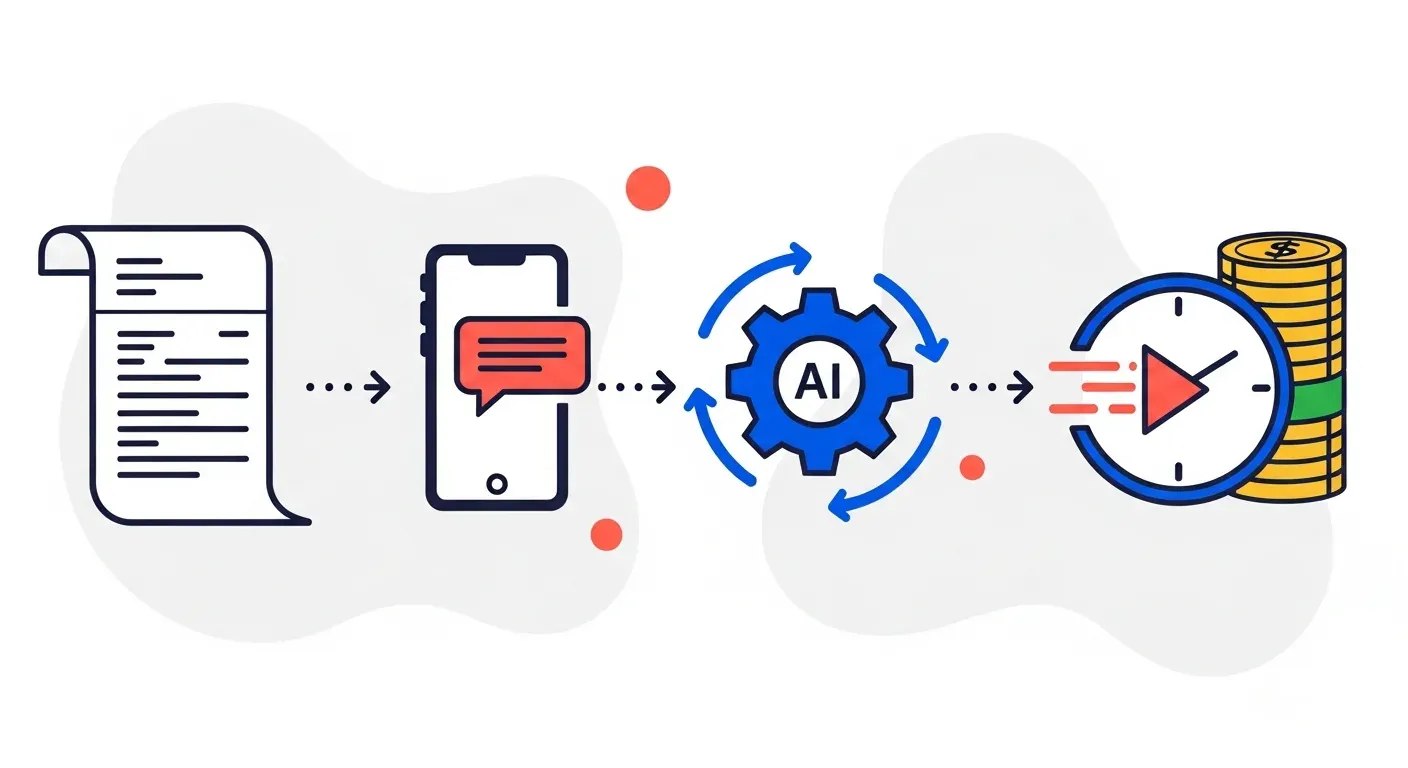
Yes, AI can meaningfully accelerate how fast you get paid. It automates payment reminders across multiple channels, predicts which invoices are at risk of going overdue, matches payments to invoices without manual effort, and escalates follow-ups intelligently. B2B companies using AI-driven AR automation typically reduce DSO by 10 to 20 days and free their finance teams from hours of repetitive collection work each week.
Late payments are not just an inconvenience. They are a drag on your cash flow, your team's time, and your ability to grow. According to industry data, 55% of B2B invoices are paid late, and the average finance team spends 14 hours per week chasing overdue payments manually.
AI changes this equation. Not by replacing your finance team, but by automating the repetitive work that slows collections down and letting your team focus on the accounts that actually need human attention.
Here are six specific ways AI helps you get paid faster.
1. Automated multi-channel follow-ups
The most immediate impact of AI in accounts receivable is automating payment reminders. Instead of someone on your team manually emailing customers about overdue invoices, AI sends the right message, on the right channel, at the right time.
This goes beyond basic email automation. AI-powered platforms like Yonovo follow up across email, SMS, WhatsApp, and AI voice calls. Each channel reaches customers differently:
- Email works well for initial reminders and documentation, but open rates hover around 20% and decline with each subsequent message.
- SMS has a 90% open rate and 45% response rate, making it far more effective for time-sensitive reminders.
- WhatsApp reaches 95% open rates in markets where it is the dominant messaging platform.
- AI voice calls provide the persuasiveness of a phone call without requiring your team to dial.
The reason this matters for speed is simple: if a customer does not see your reminder, they do not pay. Reaching them on the channel where they actually engage gets invoices resolved days or weeks faster than email alone.
For a deeper look at how channel selection impacts collection speed, see our guide on multi-channel payment chasing.
2. Predictive payment risk scoring
Traditional AR management is reactive. You wait for an invoice to go overdue, then you start chasing it. AI flips this by analyzing patterns in your customer payment history to predict which invoices are likely to be paid late before they become overdue.
Here is what AI looks at to build a payment risk score:
- Historical payment behavior. How often has this customer paid late? By how many days?
- Invoice characteristics. Larger invoices, invoices without purchase order numbers, and invoices sent to certain contacts tend to have different payment timelines.
- Seasonal patterns. Some customers slow down payments at quarter-end or during specific months.
- Communication engagement. Has the customer opened recent reminder emails? Have they clicked payment links?
With these signals, AI can flag high-risk invoices early, so your team can intervene before the invoice goes overdue. This might mean sending a courtesy reminder a few days before the due date, reaching out to a secondary contact, or switching to a more direct channel like SMS.
The result is fewer invoices sliding into the 30, 60, or 90-day aging buckets, which is where the real cash flow damage happens.
3. Intelligent escalation sequences
Not every overdue invoice needs the same level of attention. A $500 invoice from a reliable customer who is three days late is very different from a $50,000 invoice from a new customer who is 30 days overdue.
AI handles this by building escalation sequences that adjust based on the context:
- Low-risk, low-value invoices get a standard email reminder sequence. If the customer has a strong payment history, the tone stays friendly and the frequency is lower.
- High-risk or high-value invoices escalate faster. The system might move from email to SMS within a few days, then to a voice call within a week.
- Unresponsive accounts trigger escalation to a senior contact at the customer company, or route the account to your AR team for personal outreach.
This is the kind of prioritization that is nearly impossible to do manually when you are managing dozens or hundreds of open invoices. AI applies consistent rules across every invoice, every day, without anything slipping through the cracks.
TDG Inc reduced manual follow-ups by 80% and cut DSO by 15 days within three months after implementing automated escalation sequences with Yonovo.
4. Automatic payment matching and reconciliation
Getting paid faster is not only about chasing invoices. It is also about processing payments efficiently once they arrive. Manual reconciliation, where someone on your team matches each incoming payment to the correct open invoice, is one of the most time-consuming tasks in AR.
AI automates this by matching payments to invoices based on reference numbers, amounts, customer identifiers, and historical patterns. When a payment comes in, the system identifies which invoice it applies to and updates your records automatically.
This matters for collection speed because:
- Faster reconciliation means faster follow-up. If a partial payment comes in and is not matched for three days, your reminder system might still be chasing the full amount. Real-time matching keeps your follow-up sequences accurate.
- It eliminates duplicate reminders. Sending a reminder for an invoice that was already paid damages customer relationships and wastes your team's credibility.
- It surfaces exceptions immediately. When a payment does not match cleanly, AI flags it for human review rather than letting it sit in a queue.
Platforms that integrate directly with your accounting software, whether that is QuickBooks, Xero, NetSuite, Sage, or Odoo, keep reconciliation in sync without requiring manual data transfers between systems.
5. Real-time AR visibility and reporting
You cannot improve what you cannot see. One of the less obvious ways AI helps you collect faster is by giving you real-time visibility into your entire receivables position.
Instead of pulling aging reports from a spreadsheet once a week (or once a month), AI-powered AR dashboards show you:
- Current DSO and how it is trending over time
- Aging breakdown by bucket (current, 1-30, 31-60, 61-90, 90+)
- At-risk invoices flagged by the predictive scoring system
- Customer payment patterns showing which accounts are consistently slow
- Collection activity showing which reminders were sent, opened, and responded to
This visibility lets you make decisions faster. If you see a large invoice approaching 30 days overdue, you can escalate it immediately instead of discovering it during a monthly review. If a specific customer segment is trending toward slower payments, you can adjust credit terms before the problem compounds.
For more on the metrics that matter, see our guide on how to reduce DSO, which covers benchmarks and tracking strategies for different industries.
6. Consistent follow-up that never drops the ball
This is arguably the most important capability, and the simplest. AI does not forget. It does not get busy with other tasks. It does not deprioritize a $2,000 invoice because a $50,000 deal needs attention.
Manual collections suffer from inconsistency. When your AR team is handling invoicing, reconciliation, dispute resolution, and follow-ups simultaneously, some accounts will inevitably be neglected. Research shows that the probability of collecting an invoice drops significantly after 90 days. Every day of delayed follow-up makes collection less likely.
AI sends every reminder on schedule, across every account, regardless of volume. When your team is out sick, on vacation, or swamped with month-end close, the collection process continues without interruption.
Troyes experienced this firsthand. They went from fully manual collections to fully automated in a single day after connecting Yonovo to their accounting system. The reminders went out on time, across email, SMS, and WhatsApp, without anyone on their team needing to send a single message manually.
What AI does not replace
AI is powerful for the operational side of collections. But it does not replace the judgment calls that finance teams make every day:
- Negotiating payment plans with a customer going through financial difficulty
- Deciding when to adjust credit terms for a strategic account
- Managing sensitive relationships where an aggressive collection approach would cause more harm than good
- Identifying systemic issues in your billing or invoicing process that cause disputes
The best results come when AI handles the volume and consistency, and your team handles the strategy and relationships. This is not about choosing between people and technology. It is about putting each where they add the most value. (Worried about your role? See will AI replace my accounts receivable job, and for the upside, how much time AI can save in collections.)
How much faster can you actually get paid?
The numbers vary by company, but the patterns are consistent across industries:
- DSO reduction of 10 to 20 days within the first two to three months is typical for companies moving from manual to AI-powered collections.
- 70 to 80% reduction in time spent on manual follow-ups, freeing your AR team for higher-value work.
- Higher collection rates on aging invoices, particularly in the 30 to 60-day bucket where early intervention prevents write-offs.
The impact is especially significant in industries with long payment cycles and high invoice volumes, such as manufacturing, wholesale distribution, and professional services. In these sectors, even a modest DSO improvement translates to meaningful working capital gains.
For context, reducing DSO by 15 days on $2M in monthly revenue frees up roughly $1M in working capital. That is cash you can use to fund operations, invest in growth, or reduce reliance on credit lines.
Getting started
If your team is still chasing payments manually, the question is not whether AI can help you collect faster. The evidence is clear that it can. The question is how quickly you can implement it.
Modern AI-powered AR platforms connect to your existing accounting software and start automating follow-ups within hours, not months. You do not need a large IT project or a system overhaul. You need a platform that integrates with the tools you already use and applies intelligent automation to the collection process you already have.
Book a demo with Yonovo to see how AI-powered follow-ups across email, SMS, voice, and WhatsApp can reduce your DSO and get your team out of the payment-chasing cycle. You will see your own invoices, your own customers, and a clear picture of how much faster you could be collecting.
Frequently Asked Questions
How does AI help collect payments faster?
AI accelerates collections by automating the entire follow-up process. It sends payment reminders on schedule across email, SMS, WhatsApp, and voice calls. It analyzes payment history to predict which invoices are likely to go overdue and prioritizes those for earlier outreach. It also matches incoming payments to open invoices automatically, eliminating manual reconciliation delays.
Can AI replace my AR team?
No. AI handles the repetitive, time-consuming parts of collections, like sending reminders, tracking aging, and reconciling payments. This frees your AR team to focus on work that requires human judgment, such as resolving disputes, managing key account relationships, and improving credit policies. The goal is to make your existing team more effective, not to replace them.
How much can AI reduce my DSO?
Most B2B companies see a DSO reduction of 10 to 20 days within the first two to three months of implementing AI-powered AR automation. The exact improvement depends on your starting DSO, invoice volume, customer mix, and how consistent your current follow-up process is. Companies with inconsistent manual processes tend to see the largest gains.
Is AI-powered AR automation hard to set up?
Modern AI AR platforms connect directly to your accounting software, such as QuickBooks, Xero, or NetSuite. Setup typically involves syncing your invoices and customer data, configuring your follow-up rules, and activating the channels you want to use. Many teams are fully operational within a day. Troyes, for example, went from fully manual collections to fully automated in a single day.
What size company benefits from AI in accounts receivable?
Any B2B company that invoices customers on credit terms can benefit. The ROI is most immediate for companies processing 50 or more invoices per month, where manual follow-up consumes significant time. But even smaller teams benefit from the consistency and multi-channel reach that AI provides, since the issue is not just volume but the reliability of follow-up.