


Connecting an AR tool to your ledger is safe when the access is read only, the data is encrypted in transit and at rest, you can delete it on request, and the vendor does not train AI models on it. Those four answers matter more than any certification logo. Ask them before the demo ends, and get them in writing.
Somewhere near the end of most AR automation demos, after the sequences and the inbox and the pricing, a controller asks the question that actually decides the deal.
"So you are going to read our AR. You are going to pull all that data and store it somewhere. How long do you keep it?"
It is a good question and it is usually asked too late. By that point the buyer has spent forty minutes on features and five on the thing that will get them fired if it goes wrong.
Connecting a third party tool to your ledger is a reasonable thing to do. Finance teams do it constantly, with payment processors, expense platforms, and reporting tools. But it is worth doing deliberately. Here are the questions that matter, why each one matters, and what a good answer sounds like.
1. Is the access read only?
This is the first question and it eliminates the most risk.
Collections needs to know which invoices are open, how overdue they are, what the balance is, and how to reach the customer. It does not need to create invoices, edit customer records, change contact details, or post payments. Everything the automation does happens outside your accounting system: emails, texts, calls, and a record of what was sent.
Read only access means that no bug, no misconfiguration, and no compromised credential on the vendor side can alter your ledger. That is a meaningful reduction in exposure, and it costs you nothing in functionality.
Good answer: "We read invoices, aging, and contacts. We never write back. We do not change contact information and we do not post payments."
If a vendor wants write access, ask precisely which feature requires it, and whether you can turn that feature off and keep read only.
2. Where does the data physically live?
Most platforms run on AWS, Google Cloud, or Azure. That is fine. The question is which region, because region determines which laws apply.
If you are a Canadian company and your AR data sits in a US region, that is a fact your legal or compliance team needs before you sign. Same for EU and UK businesses. It is often perfectly acceptable, but it should be a decision rather than a discovery.
Good answer: A named provider and a named region, offered without hesitation.
Yonovo runs on AWS infrastructure in the United States. We say that on sales calls before anyone asks, because it is the kind of thing that should never surface after a contract is signed.
3. Is the data encrypted in transit and at rest?
This is table stakes in 2026, which means the answer will always be yes, which means the follow-up question is where the value is: what happens to the data between those two states?
Ask how credentials for your accounting system are stored, whether staff can access customer data and under what controls, and whether access is logged. "Encrypted at rest" is a checkbox. Access control is the part that actually prevents incidents.
Good answer: Encryption in both states, credentials held in a dedicated secrets store, internal access restricted and logged.
4. Do you train AI models on our data?
This is the question buyers most often skip, and it has become the most important one on the list.
AR automation platforms use AI to draft replies, adapt message tone, and handle voice calls. Those capabilities usually run on third party model providers. The terms that govern whether your data contributes to model training vary between providers, between tiers of the same provider, and over time.
Your AR data is commercially sensitive in a specific way: it reveals who your customers are, what you charge them, and which of them pay late. That is a competitive profile of your business, and it is not something you want absorbed into a general purpose model.
Good answer: An explicit no, covering both the vendor's own systems and any downstream model provider, ideally referenced in the contract rather than only on a call.
Yonovo does not use customer data to train language models. There is no product reason to. The follow-up sequences work on your data to serve you, and once your account is gone there is no reason for us to hold any of it.
5. How long do you keep it, and what happens when we leave?
Vendors generally retain data for the life of the account, which is reasonable. The communication history is what makes the platform useful. A follow-up email that references what the customer said three weeks ago only works if that record exists.
The real questions are about the exit:
- Can you request full deletion when you close the account?
- Is deletion confirmed, and within what timeframe?
- Does deletion cover backups, and how long do backups persist?
- Can you export your communication history and records on the way out?
- Is any of that gated behind a fee or a notice period?
Backups are where deleted data quietly survives. Most providers hold them for thirty to ninety days. That is normal and defensible, but you should know the number.
Good answer: Deletion on request, at no cost, confirmed, with a stated backup window.
6. Which is safer, a direct integration or a CSV export?
Teams on closed or legacy ERPs often end up sending a scheduled export instead of connecting an API, and they sometimes assume that is the less secure option. It is not straightforwardly worse. It is a different shape of risk.
Direct integration means the vendor holds credentials to your accounting system. Larger blast radius if those credentials are compromised, but the data never travels through email and access can be scoped and revoked centrally.
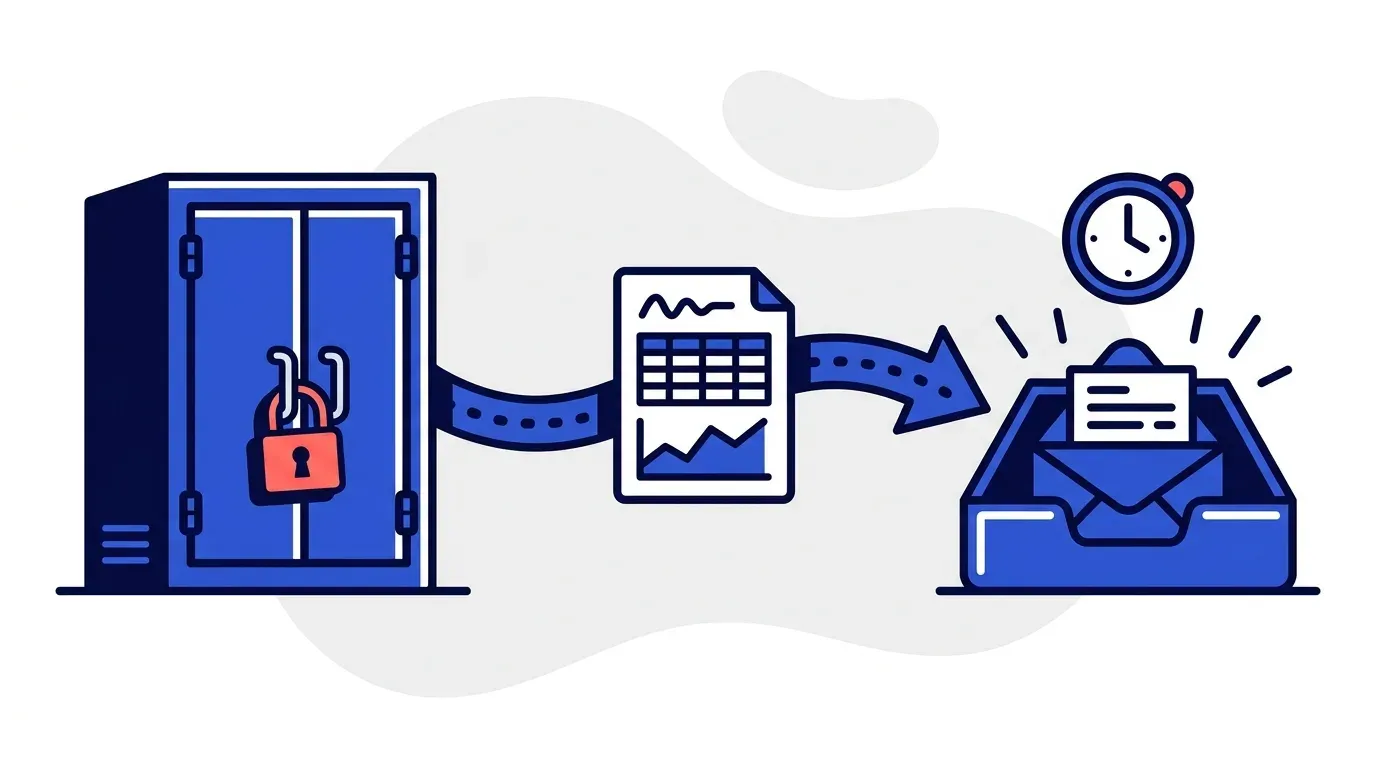
Scheduled export means no credentials are held at all, but AR data moves through email in transit. Mitigate that by sending to a dedicated import address, limiting the report to what is actually needed, and never including bank details or payment credentials in the file.
Either way, the data set should be limited to invoice numbers, amounts, dates, balances, and customer contacts. An AR automation platform has no reason to receive your bank details, your customers' payment methods, or your general ledger. If a vendor asks for more than the follow-up requires, ask why.
7. What certifications do you actually have?
Certification logos are useful signals, not guarantees. SOC 2 Type II tells you a firm audited a set of controls over a period. ISO 27001 tells you a management system exists. Neither tells you whether your specific data is handled the way you need.
The honest framing is this: for a large enterprise with a procurement process, certifications are a hard requirement and there is no point arguing with that. For a mid market finance team, the answers to questions one through five tell you more about real risk than a badge on a website does.
Ask what a vendor has, ask what is in progress and on what timeline, and weigh it against your own compliance obligations rather than treating it as a pass or fail.
8. What happens when something goes wrong?
Finally, ask about incidents. Not whether they have had one, since the answer is unfalsifiable, but about process:
- How would you be notified of a breach affecting your data, and how quickly?
- Who is the named contact when something breaks?
- Is there a status page?
- What is the support channel and its response expectation?
Vendors who work closely with customers usually operate in a shared Slack or Teams channel, which makes the answer concrete rather than theoretical. That is how we work, and it means the escalation path is a message rather than a ticket queue.
The short list
If you take one thing from this, take these four questions and ask them before the demo ends:
| Question | What you want to hear |
|---|---|
| Is access read only? | Yes, we never write to your ledger |
| Where is the data stored? | A named provider and region |
| Do you train AI on our data? | No, and not our model providers either |
| Can we delete everything on exit? | Yes, free, confirmed, backups included |
Four answers, two minutes. They tell you more than an hour of feature demonstration.
If you are earlier in the process and still working out whether automation fits your operation at all, how to know if your AR process needs automation is the better starting point. For teams on closed systems weighing the export route, how to automate AR when your ERP has no API covers the tradeoffs in more depth.
And if you want these answers about Yonovo specifically, book a demo and ask. We would rather cover it on the first call than the fifth.
Frequently Asked Questions
Does AR automation need write access to my accounting system?
It should not. Collections requires reading open invoices, aging, and customer contacts. It does not require creating invoices, editing customer records, or posting payments. Read only access is the correct default and it removes the entire category of risk where a bug or misconfiguration corrupts your ledger. If a vendor asks for write access, ask exactly which operation requires it and whether you can decline.
Where is my accounts receivable data stored?
Ask the vendor directly, because the answer determines your compliance position. Most platforms use a major cloud provider such as AWS, Google Cloud, or Azure, and the region matters. If you operate in Canada, the EU, or the UK and your data is stored in the United States, that is something your legal team needs to know before you sign, not after. Yonovo stores data on AWS infrastructure in the United States.
Will my customer data be used to train AI models?
This is the question most buyers forget to ask. Many AI features are built on third party model providers, and the terms governing whether your data feeds model training vary widely. Get an explicit no in writing, covering both the vendor's own models and any downstream provider they use. Yonovo does not use customer data to train language models.
How long does an AR automation vendor keep my data?
Typically for the life of the account, since the follow-up history is what makes the tool useful. What matters is what happens at the end. You should be able to request full deletion when you close the account and get confirmation that it has happened, including from backups within a stated window. Ask for the retention period on backups specifically, because that is where deleted data usually lingers.
What happens to my data if we stop using the platform?
You should be able to export your communication history and invoice records, and request deletion of everything the vendor holds. Confirm both are available without a fee and without a contractual notice period that delays them. A vendor that makes exit difficult is telling you something about how they view the relationship.
Is emailing a CSV export less secure than a direct integration?
It is a different risk profile rather than a straightforwardly worse one. An integration means holding credentials to your accounting system, which is a larger blast radius if compromised. An emailed export means AR data in transit through email, which should be limited to a dedicated import address and should never include payment credentials or bank details. Neither approach requires sharing anything beyond invoice, balance, and contact information.